

5 of the Most Effective Ways to Boost Your Credit Score Before Buying a Home
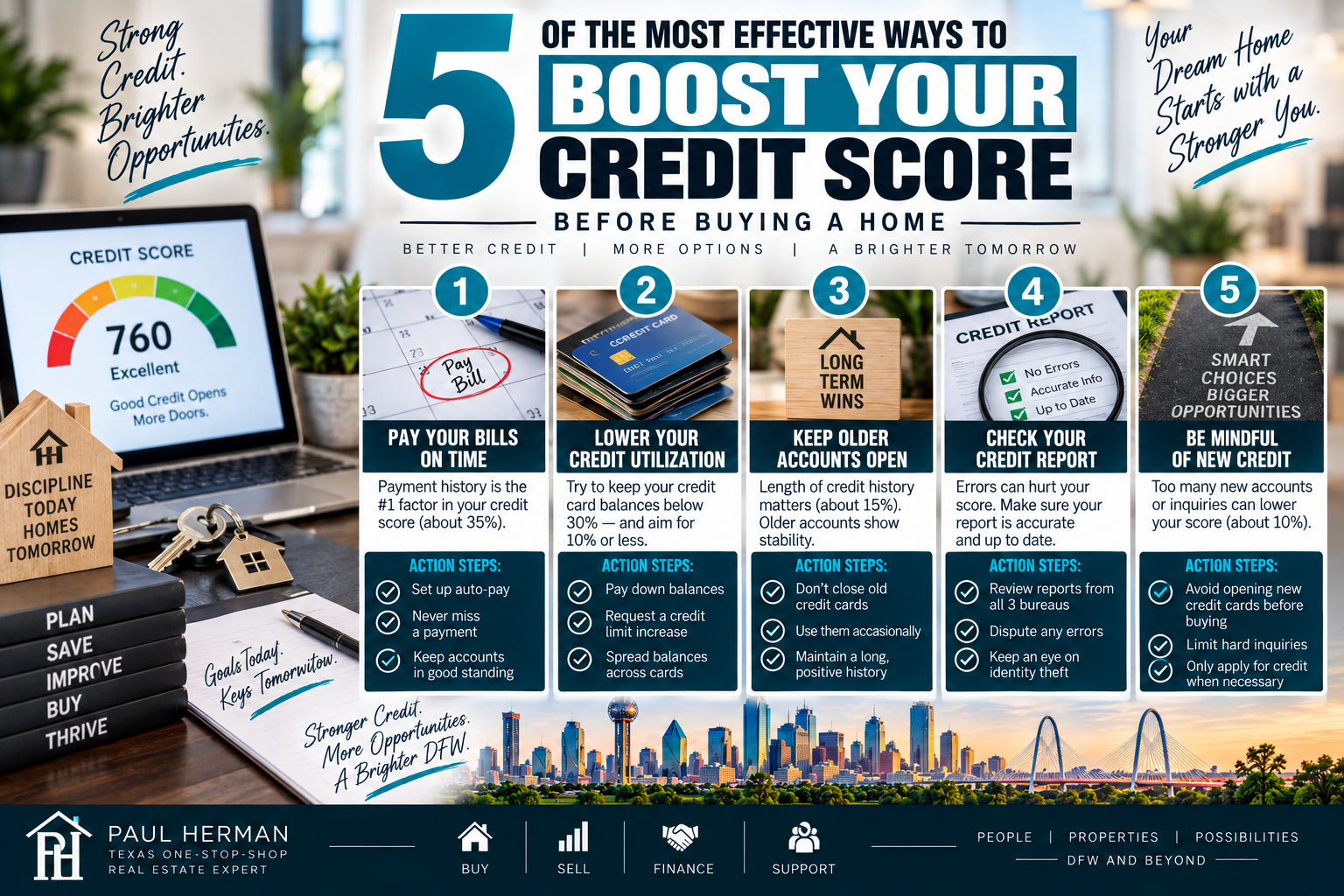
5 of the Most Effective Ways to Boost Your Credit Score Before Buying a Home
When people start thinking about buying a home, they usually focus on two things:
How much house can I afford? How much money do I need for a down payment?
But there's another piece of the home-buying puzzle that can have a major impact on your financing:
Your credit.
Your credit profile can influence whether you qualify for certain mortgage programs, your interest rate, mortgage insurance costs, and ultimately how much your home may cost you each month.
The good news?
You don't necessarily need perfect credit to buy a home, and there are steps you can take to put yourself in a stronger financial position before applying for a mortgage.
Here are five of the most effective strategies I discuss with buyers who want to prepare their credit for homeownership.
1. Make Every Payment on Time
If there's one habit I want buyers to prioritize, it's this:
Pay your bills on time—every single month.
Payment history is a major component of commonly used credit-scoring models. FICO says payment history represents about 35% of a typical FICO Score, although the exact effect varies by individual credit profile.
Late payments can potentially have a significant impact, particularly when they're reported to the credit bureaus.
That means staying current on:
- Credit cards
- Auto loans
- Student loans
- Personal loans
- Existing mortgages
- Other accounts reported to the credit bureaus
One of the simplest strategies is to set up automatic minimum payments as a safety net and then make additional payments separately.
The goal is simple:
Don't allow an avoidable missed payment to create a problem while you're preparing to purchase a home.
2. Pay Down Credit Card Balances
This can be one of the most important areas to evaluate when someone wants to improve their credit profile.
Credit utilization looks at how much of your available revolving credit you're currently using.
For example:
If you have a credit card with a $10,000 limit and carry a $7,000 balance, you're using 70% of that available credit.
If you reduce the balance to $2,000, you're using 20%.
Lower utilization generally indicates less reliance on available revolving credit and can benefit credit scores. FICO identifies "amounts owed," including utilization, as another major scoring category.
Where Should You Start?
If you have several cards, don't automatically assume the only strategy is paying off the card with the smallest balance.
Before applying for a mortgage, it can be helpful to evaluate:
Which balance reduction could have the greatest positive impact on my overall credit profile and mortgage qualification?
Sometimes strategically reducing revolving balances can help your credit profile while also reducing monthly debt obligations.
That's why I like reviewing this before buyers start moving money around.
3. Don't Close Old Credit Cards Just Because You've Paid Them Off
This one surprises a lot of people.
Imagine you've had a credit card for 10 years.
You finally pay it off and think:
"Great. I don't need this anymore. I'm going to close it."
Not so fast.
Closing an established revolving account can reduce your available credit and therefore potentially increase your utilization ratio. Account age can also factor into credit-scoring models.
For example:
You have two cards:
Card A: $10,000 limit Card B: $10,000 limit
You owe $4,000 total.
With both cards open, that's $4,000 used out of $20,000 available.
If you close one of those cards and your available revolving credit falls to $10,000, the utilization picture can change substantially.
That doesn't mean you should never close a credit card. There may be good reasons to do so, especially if the card carries an annual fee or creates another concern.
But when you're preparing for a mortgage:
Don't make major changes to your credit profile without first understanding the potential consequences.
4. Avoid Opening New Debt Before Buying Your Home
You're getting ready to buy a house.
So naturally, you start thinking about everything you'll need for it.
New furniture.
A refrigerator.
Maybe a new truck.
And then the store offers:
"0% financing!"
It sounds harmless.
But this is exactly when I want my buyers to be careful.
Opening a new credit account can result in a hard inquiry, add a new account to your credit profile, and potentially create a new monthly obligation.
And for mortgage qualification, that last part can be particularly important.
Your lender evaluates your debt-to-income ratio, which compares certain monthly debt obligations with your income.
That new $700 truck payment or $250 furniture payment may affect how much mortgage you qualify for.
My recommendation during the mortgage process:
Don't finance anything significant without talking to your mortgage professional first.
That includes:
- Cars
- Furniture
- Appliances
- Credit cards
- Personal loans
- Buy-now-pay-later financing
- Co-signing for someone else's debt
Even if you've already been pre-approved.
Pre-approved doesn't mean your financial profile stops being reviewed.
Your lender may review your credit and financial information again before closing.
5. Review Your Credit Early — Not a Week Before You Want to Buy
This may be the most important advice in this entire article.
Don't wait until you've found the perfect house to start thinking about your credit.
I would much rather have a conversation with someone six months before they're ready to purchase than after they've already fallen in love with a home.
Starting early gives us time to identify potential issues and develop a plan.
Consumers can review their credit reports from the three nationwide credit bureaus through the federally authorized AnnualCreditReport.com site. The Federal Trade Commission recommends reviewing your reports and disputing errors you find.
Look for things such as:
- Incorrect late payments
- Accounts you don't recognize
- Incorrect balances
- Duplicate accounts
- Collection accounts
- Outdated information
- Potential identity-theft issues
If something is inaccurate, there are formal processes for disputing that information with the credit bureaus and the company that supplied it.
And there's another important distinction:
The credit score you see online may not necessarily be the same score used for your mortgage.
Different lenders and lending products may use different scoring models or versions, so buyers shouldn't assume a consumer score from an app automatically tells them whether they'll qualify for a mortgage—or what rate they'll receive.
Your Credit Score Can Affect More Than Just Getting Approved
This is where buyers sometimes underestimate the importance of credit.
The question isn't always simply:
"Can I qualify?"
A better question may be:
"How can I put myself in the strongest financial position when I qualify?"
Depending on the loan program and your overall financial profile, stronger credit may potentially help you obtain:
- Better interest-rate options
- Lower borrowing costs
- More financing choices
- Better mortgage-insurance pricing
- A more comfortable monthly payment
Even a relatively small difference in borrowing costs can become meaningful when you're financing hundreds of thousands of dollars over many years.
That's why credit preparation should be part of your home-buying strategy, not an afterthought.
Related Reading


Our mission is to provide exceptional customer service to our clients by taking the time to understand their unique needs and goals.

